

On reclaiming a life from velocity
/
There is a particular kind of forgetting that happens slowly, beneath the surface of a functioning life. It does not announce itself as crisis. It arrives disguised as competence, reliability, and momentum. You wake up each day, move through the hours, meet expectations, and call it living, while something essential inside you quietly recedes.
For a long time, I believed that this erosion was simply the cost of adulthood. That to be serious in the world, to provide, to contribute, to matter; required a gradual departure from the self. I mistook this departure for maturity. I believed that if I could endure enough, override enough, surrender enough of my inner life, I would eventually be rewarded with stability or peace.
Instead, I became efficient at disappearance.
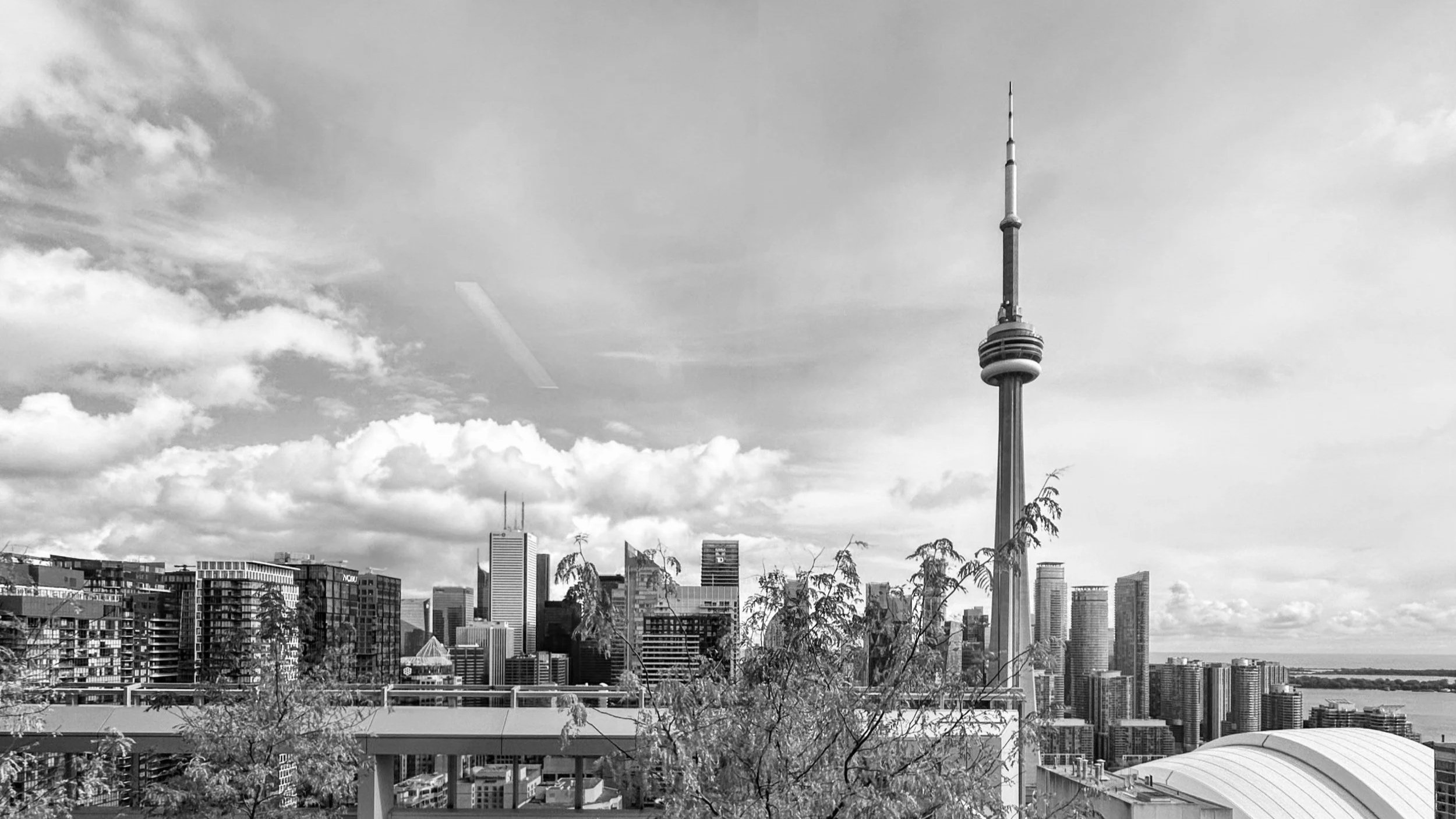
The city reinforced this belief. Toronto; dense, intelligent, relentless, teaches you how to move. How to measure yourself against motion. How to synchronize your worth with pace. The streetcars arrive when they arrive. The sidewalks surge and stall. The skyline keeps reaching upward, indifferent to who collapses beneath it. There is beauty here, but also a kind of spiritual friction. A sense that if you slow down, you will be absorbed or left behind.
I learned how to live in fragments: mind racing ahead, body trailing behind, spirit left unattended. I learned to override hunger, fatigue, grief, intuition. I learned how to perform clarity while feeling increasingly unmoored. And because the world rewarded this performance, I believed it was proof of alignment rather than evidence of rupture.
But there is a law beneath all others: what is ignored does not disappear, it waits.
Eventually, my body began to speak in a language I could no longer translate away. My nervous system refused the tempo I demanded of it. My inner life grew louder, not in protest, but in warning. What I once called discipline began to feel like violence. What I once called ambition began to feel hollow.
This was not burnout in the casual sense. It was a metaphysical reckoning. A realization that I had organized my life around values that could not sustain a soul.
Reclamation did not come through collapse, but through attention. Through the quiet act of turning inward and asking a question I had avoided for years: What am I aligned with, and what has that alignment cost me?
I began to understand that much of modern suffering is not rooted in failure, but in misdirection. We are taught to chase outcomes while abandoning coherence. To seek success without asking whether the self required to achieve it is one we can live inside. We confuse motion with meaning, accumulation with purpose.
Spiritual traditions have always warned against this. They speak of right relation, of harmony between inner and outer life, of the dangers of speed without wisdom. I had read these ideas before. What I lacked was the courage to live them.
Becoming a father dissolved whatever resistance remained.
Children are metaphysicians without language. They live in presence. They understand time not as a resource to be spent, but as something to be inhabited. My daughter did not ask me to be impressive. She asked me to be there. Fully. Calmly. Without drift.
In her presence, I could no longer justify the life I was modeling. I could not teach her self-trust while ignoring my own. I could not speak of worth while living as if mine were conditional on output. Parenthood did not add meaning to my life, it exposed where meaning had gone missing.
Slowing down was not an act of retreat; it was an act of realignment. Choosing health was not self-interest; it was moral clarity. Reclaiming my inner life became a spiritual practice, not separate from work or responsibility, but foundational to them.
I began to walk the city differently. To notice how winter forces stillness, how the lake holds a horizon the towers cannot erase, how even here, amid glass and concrete, there are invitations to breathe. The city did not change. I did.
My ambition did not disappear. It underwent initiation. It shed its hunger for external validation and learned to answer a deeper call: Does this preserve my integrity? Does this allow me to remain present, loving, and awake?
This shift required grief. I mourned the version of myself who was praised for endurance but starved of rest. I let go of identities built on being endlessly capable. I accepted that choosing coherence would sometimes look like withdrawal to those who measure worth by visibility alone.
But what emerged was something sturdier than approval: internal authority.
I no longer aspire to do more at the cost of myself. I aspire to live in right relation, with my body, my child, my work, and the unseen architecture of meaning that holds a life together. I am no longer interested in surviving systems that require my disappearance. I am interested in building a life that can be fully inhabited.
This is not a rejection of the world. It is a refusal to be consumed by it.
A life that demands your body, your spirit, or your capacity for love as payment is too expensive, no matter how noble the language used to justify it.
What I am learning now is older than any city and quieter than ambition:
That a life aligned with truth moves more slowly, but carries further. That presence is not passive, it is power. And that to remain intact in a world that profits from fragmentation is not weakness. It is a form of devotion.
— Sincerely Boris